
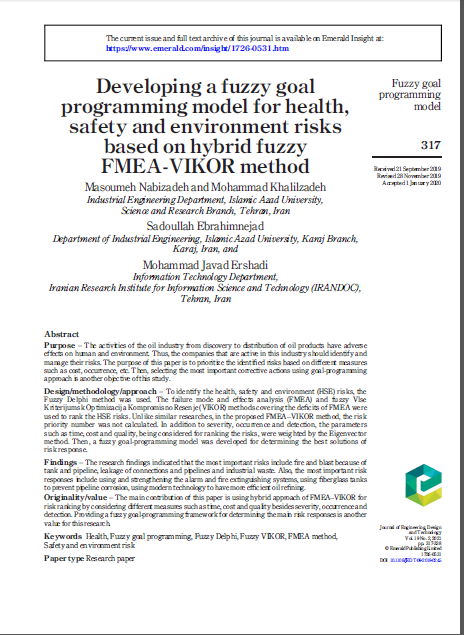
Purpose: The activities of the oil industry from discovery to distribution of oil products have adverse effects on humans and the environment. Thus, the companies active in this industry should identify and manage their risks. The present study was conducted in the National Iranian Oil Refining and Distribution Company.
Design/methodology/approach: to identify the HSE risks, the fuzzy Delphi method was used. The FMEA and fuzzy VIKOR methods covering the deficits of FMEA were used to rank the HSE risks. Based on the research background, the RPN number in FMEA had no scientific basis and the relative weight of probability Occurrence, severity, and detection were not considered. In the FMEA-VIKOR method, the RPN number was not calculated. The other calculations were conducted by the VIKOR method. In addition to severity, occurrence, and detection, the parameters of time, cost, and quality, being considered for ranking the risks, were weighted by the Eigenvector method. Then, a fuzzy goal programming model was developed for determining the best solutions to risk response.
Findings: The research findings indicated that the most important risks include fire and blast due to tank and pipeline, leakage of connections and pipelines, and industrial waste and the most important solutions include using and strengthening the alar and fire extinguishing systems, using fiberglass tanks to prevent pipeline corrosion, using modern technology to have better and more efficient oil refining.
Originality/value: This study investigates the quantitative and qualitative analysis of HSE risks in the oil and gas industry and the risk response strategy.
Nabizadeh, Masoume, Mohammad Khalilzadeh, Sadoullah Ebrahimnejad, and Mohammad Javad Ershadi. 2021. Developing a Fuzzy Goal Programming Model for Health, Safety, and Environment Risks Based on Hybrid Fuzzy FMEA-VIKOR Method. Journal of Engineering Design and Technology 19 (2): 317-338.