
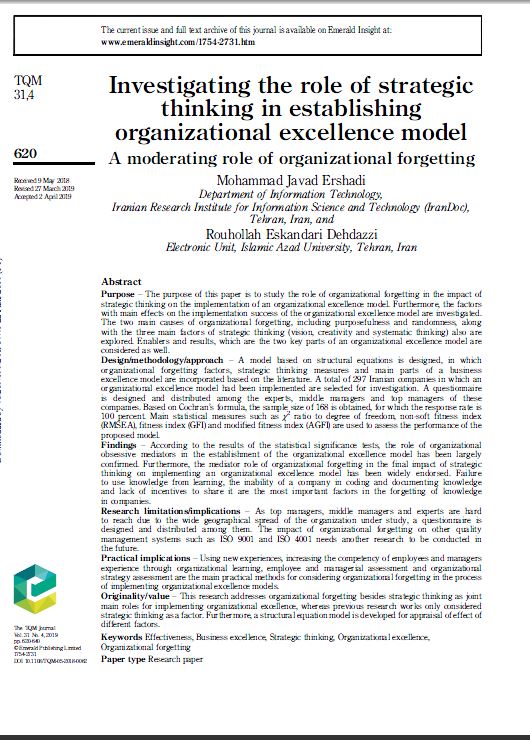
Purpose: In this research, the role of organizational forgetting in the impact of strategic thinking on the implementation of an organizational excellence model is studied. Furthermore, the factors with main effects on the implementation success of the organizational excellence model are investigated. The two main causes of organizational forgetting, including purposefulness and randomness along with the three main factors of strategic thinking (vision, creativity, and systematic thinking) also are explored. Enablers and results, which are the two key parts of an organizational excellence model are considered as well.
Design/methodology/approach: A model based on structural equations is designed, in which organizational forgetting factors, strategic thinking measures, and main parts of a business excellence model are incorporated based on literature. A total of 297 Iranian companies for which an organizational excellence model had been implemented are selected for investigation. A questionnaire is designed and distributed among the experts, middle managers, and top managers of these companies. Based on the Cochran's formula the sample size of 168 is obtained, for which the response rate is 100%. Main statistical measures such as Chi-square ratio to degree of freedom, Non-soft Fitness Index (RMSEA), Fitness Index (GFI), and Modified fitness index (AGFI) are used to assess the performance of the proposed model.
Findings: According to the results of the statistical significance tests, the role of organizational obsessive mediators on the establishment of the organizational excellence model has been largely confirmed. Furthermore, the mediator role of organizational forgetting on the final impact of strategic thinking on implementing an organizational excellence model has been widely endorsed. Failure to use knowledge from learning, the inability of a company in coding and documenting knowledge and lack of incentives to share it, are the most important factors in the forgetting of knowledge in companies.
Research limitations/implications: As top managers, middle managers, and experts are hard to reach directly due to the wide geographical spread of the organization under study, a questionnaire is designed and distributed among them. The impact of organizational forgetting on other quality management systems such as ISO 9001 and ISO 4001 needs another research to be conducted in the future.
Practical implications: The main practical methods for considering organizational forgetting in the implementing organizational excellence models are suggested in this paper. Using new experiences; increasing the competency of employees and managers experience through organizational learning; employee and managerial assessment and organizational strategy assessment are the main subjects in this regard.
Originality/value: The originality of this research is investigating the role of organizational forgetting on business excellence implementation. A structural equation model (SEM) is used for assessing unobservable latent constructs and their related interrelationship.
Ershadi, Mohammad javad, and Rouhollah Eskandari Dehdazzi. 2019. Investigating the Role of Strategic Thinking on the Establishing of Organizational Excellence Model: A Moderating Role of Organizational Forgetting. The TQM Journal 31 (4): 620-640.